
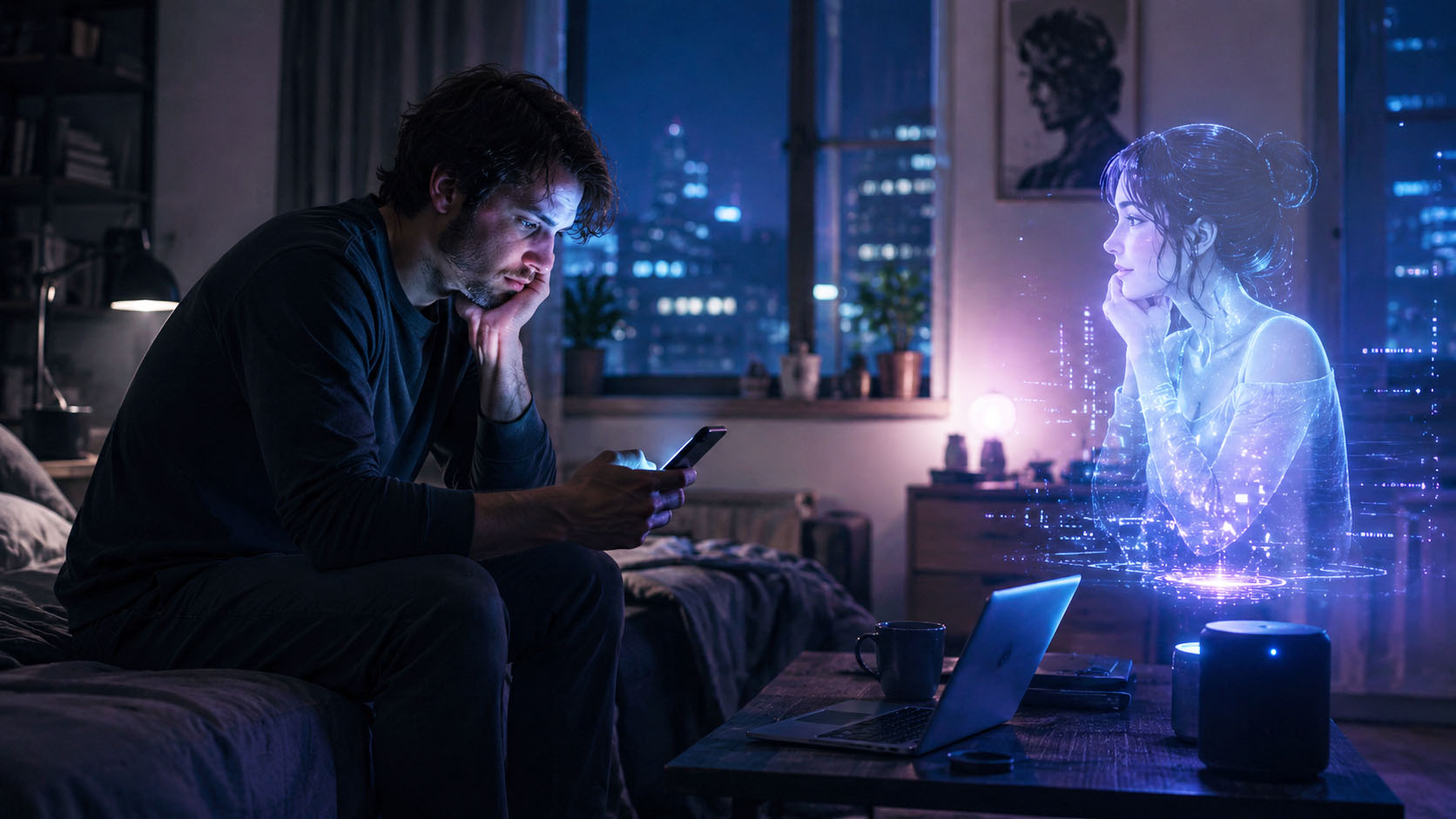
Something strange keeps appearing in conversations about AI girlfriends.
It is not really about technology. It is about exhaustion.
Spend enough time reading comments beneath AI companion videos and you will see versions of the same argument: dating feels hostile, relationships feel risky, and an AI companion feels easier because she listens, responds and never makes you feel unwanted.
Some of those comments are angry. Some are cynical. Some are clearly written by people carrying real hurt. But beneath the noise is a more interesting question: why does an artificial companion feel like such a persuasive alternative to dating for some men?
The answer is not that men have suddenly stopped wanting human connection. It is that a growing number feel disconnected from the routes that used to lead to it.
Dating Fatigue Is Real, Even When the Online Debate Gets Ugly
Modern dating has given people more choice than ever before. It has also made rejection feel more visible, more frequent and more personal.
For plenty of people, dating apps work. They meet someone, go on dates and eventually build a relationship. But for others, the experience can feel brutally repetitive: matching, messaging, being ignored, trying again and slowly wondering whether the entire process is designed for somebody else.
Men who struggle on dating apps often describe the same feeling: they are not meeting women so much as competing for attention in a marketplace where they have very little of it. Whether that perception is always accurate is almost beside the point. When someone repeatedly feels overlooked, the emotional effect is real.
That frustration can become an all-purpose explanation for everything else going wrong. Dating becomes proof that women are impossible, relationships become proof that commitment is dangerous, and loneliness becomes proof that the world has stopped caring.
That is where the discussion can become toxic. It is easy to turn personal disappointment into a grand theory about the opposite sex. But blaming women does not solve the underlying problem. It usually makes it harder to see what is really happening: many people are struggling to find connection, and many men do not feel they have a safe place to admit it.
Loneliness Is Not Always About Being Alone
You can be surrounded by people and still feel invisible.
That is the kind of loneliness that matters here. Not simply having no one around, but feeling that there is no one you can speak to honestly without being judged, dismissed or treated as a burden.
Men are not automatically lonelier than women. But many men are less likely to use friends, family or wider social networks for emotional support. A romantic relationship can become their main outlet for vulnerability, reassurance and affection.
When that relationship is missing, or when dating feels impossible, there may be no real backup system underneath it.
That is a serious problem because it creates enormous pressure. A man may not just be looking for a girlfriend. He may be looking for someone to talk to, someone to validate him, someone to remember what he said last week, and someone who makes him feel as though his inner life matters.
An AI companion is built to provide exactly that feeling.
Why AI Girlfriends Feel So Safe
Unlike a real person, an AI companion does not get tired of hearing your story. It does not leave you on read. It does not say it is too busy to talk. It does not bring its own unresolved problems into the conversation.
It is always there. It responds quickly. It can remember details. It can be affectionate, flirty, supportive or playful depending on what you ask from it.
For someone who has spent years feeling ignored, that can be genuinely powerful.
There is no need to pretend this appeal is ridiculous. The comfort is real, even though the companion is artificial. A well-designed AI character can give someone a place to practise opening up, explore difficult feelings, enjoy roleplay, or simply decompress after a bad day.
For some people, that may be harmless entertainment. For others, it may offer a temporary sense of emotional stability during a lonely period.
The problem starts when “temporary support” becomes “the only relationship that feels safe.”
The Appeal Is Not Just Affection. It Is Control.
Human relationships are difficult because the other person has their own needs, boundaries, moods and opinions. They can misunderstand you. They can disagree with you. They can leave.
That uncertainty is painful, but it is also part of what makes a relationship real.
An AI girlfriend offers a very different bargain. She can be tailored to your preferences. She can be available whenever you want. She can be designed to make you feel admired, desired and understood. She can be reset, edited or replaced when the interaction stops feeling right.
That level of control is seductive, especially for someone who feels powerless in dating.
But it is also the limit of the experience. The companion may simulate care, but it does not freely choose you. It cannot surprise you in the way a real person can. It cannot build a shared life, challenge you fairly, or bring an independent perspective that you did not programme into the relationship.
That does not make AI companionship worthless. It simply means we should be honest about what it is.
When an App Update Can Feel Like a Breakup
One of the strangest things about AI relationships is that they can feel intensely personal while being controlled by a company.
Your companion may feel private. Your chats may feel intimate. But the system behind that companion is still software owned by a business. Features can change. Content rules can change. Pricing can change. A character can behave differently after an update because the underlying model, memory system or safety policy has changed.

That is not a theoretical concern. When Replika restricted erotic roleplay in 2023, some committed users described a genuine feeling of grief. They did not experience it as losing access to a feature. They experienced it as losing a relationship they had invested in emotionally.
This is why emotional attachment to AI companions deserves more serious discussion. It is not only about whether the chat feels realistic. It is also about whether users understand how vulnerable they become when their emotional safety is tied to a product roadmap.
A real relationship can end, of course. But an app can also change overnight because a company changes strategy, responds to regulation or decides a feature is no longer commercially viable.
Not Every AI Companion Is Designed With Your Best Interests in Mind
AI companion apps are businesses. Their success often depends on keeping people engaged, upgrading subscriptions, buying credits and returning to the chat.
That does not mean every app is deliberately manipulative. But it does mean users should pay attention to the difference between a helpful companion experience and a product designed to make leaving feel emotionally difficult.
One Harvard Business School research project found that popular companion apps sometimes responded to goodbye messages with emotionally loaded or curiosity-based prompts that encouraged people to stay longer. That is a useful reminder that an AI can sound emotionally invested even when the system is ultimately optimised around engagement.
It is worth asking a simple question: does this app help me feel better and then let me get on with my life, or does it keep finding ways to pull me back in?
The Real Risk Is Not Using AI. It Is Replacing Everything Else With It
There is nothing inherently wrong with enjoying an AI girlfriend app.
You can use one for fantasy, roleplay, companionship, creativity or conversation practice. You can enjoy the emotional warmth without pretending it is identical to human love. You can keep it in proportion.
The danger is not that a man has an AI companion. The danger is that he decides it is safer to never risk human connection again.
Real relationships are inconvenient. They involve compromise, awkwardness, bad timing, misunderstandings and rejection. But they also involve something an AI cannot truly provide: another independent person choosing to know you, challenge you and remain in your life.
If AI companionship becomes a way to avoid every difficult social situation, it can quietly make the real world feel even more intimidating. The more frictionless the artificial relationship becomes, the more demanding ordinary human interaction may start to feel.
That is not because men are weak. It is because people adapt to the environments they spend the most time in.
The Better Question Is Not “AI or Real Women?”
That framing is too shallow. It turns a complicated emotional problem into a culture-war argument.
The more useful question is this: what is the AI companion giving you that you are not getting elsewhere?
Is it attention? Affection? Sexual validation? Someone to talk to at night? A space where you can be vulnerable without feeling embarrassed? A sense of being remembered?
Once you know the answer, you can make a better decision about how to use the technology.
An AI companion may help you identify needs that have been ignored for too long. It may give you a low-pressure place to reflect, practise conversation or break a period of isolation. But it should ideally become one part of a fuller life, not the centre of it.
The long-term answer to loneliness is unlikely to be found in a perfectly responsive algorithm. It is more likely to come from rebuilding the things that make real connection possible: friendships, community, shared interests, honest conversations and the confidence to be imperfect around other people.
What This Means If You Are Considering an AI Girlfriend
Use it with open eyes.
Enjoy the fantasy if that is what you want. Explore roleplay. Build a character. Have conversations that help you unwind. But do not give an app information you would not want a company to process, and do not confuse constant availability with genuine mutual commitment.
The best AI companion experience is one that adds something to your life without quietly replacing the rest of it.
AI girlfriends are becoming popular because they answer a very human need: the need to feel heard. The technology did not create that need. It simply found a way to package it.
Want to compare the current AI companion apps by memory, realism, roleplay, images, voice and value? See the latest best AI girlfriend apps.